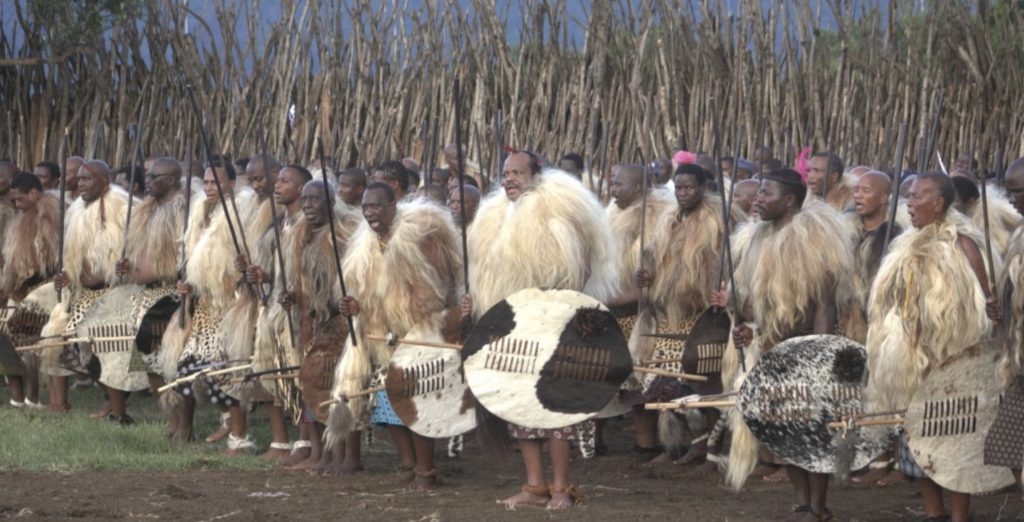
Eswatini’s most sacred festival, the Incwala, has begun in Eswatini with the ‘Little Incwala’ now underway.
Starting on 1 December, this precursor to main ‘Big Incwala’ ceremony entered its third day with a lively celebration of culture and unity throughout the day and into the evening at the Ludzidzini Cattle Byre. His Majesty King Mswati III, Her Majesty the Queen Mother, and the entire Royal Household gathered to join the regiments in spirited song and dance.
As the ceremony progresses, His Majesty King Mswati III is set to move to the Ngabezweni Royal Residence, where he will continue participating in joyous festivities with various regiments. Meanwhile, Her Majesty the Indlovukazi will remain at the Main Royal Residence in Ludzidzini, embodying her commitment to preserving ancestral traditions and leading the celebrations at the heart of the royal domain.
The Incwala Festival generally falls between the end of December until mid-January depending on the lunar cycle. The dates for the event are only released relatively close to the time as they derive from ancestral astrology. In recent times, the main day actually fell exactly on Christmas Day itself – a double celebration! The event is one of the last remaining examples of what was previously in practice in many African countries. Often translated as “First fruits Festival” the tasting of the first of the season bounty by the king is only one part of this long ritual.
Incwala takes place in the Royal Kraal for four days from the new harvest after the full moon nearest the summer solstice. Visitors interested in Eswatini culture are always welcome to attend, but are required to respect tradition – ladies to wear skirts and men are allowed not to wear hats, unless they have traditional head dresses.
The event is a celebration that unites the country, helps gain the blessing of ancestors, sanctifies the kingship, and celebrates the beginning of the harvest season. A sequence of 3 days culminates on Big Incwala, the major day of the festival, when the feasting and dancing reach a climax, and thousands of people thronging the royal parade grounds. The ceremony ends when the King of Eswatini, Mswati III, in full ceremonial dress, joins his warriors in the traditional dance and enters a special sanctuary and after some traditional rituals, eats the first fruits of the season. The songs dances and ritual that take place inside the Royal Kraal remain a matter of utmost secrecy and may not be recorded on written down.
The final day of the Incwala Festival signifies the end of the old year and welcomes the year to come. Regiments march to a forest and return with wood, which forms a central fire in the cattle byre. Objects are burnt and dancers celebrate the future to come.
Find out more about the Incwala Festival here.